
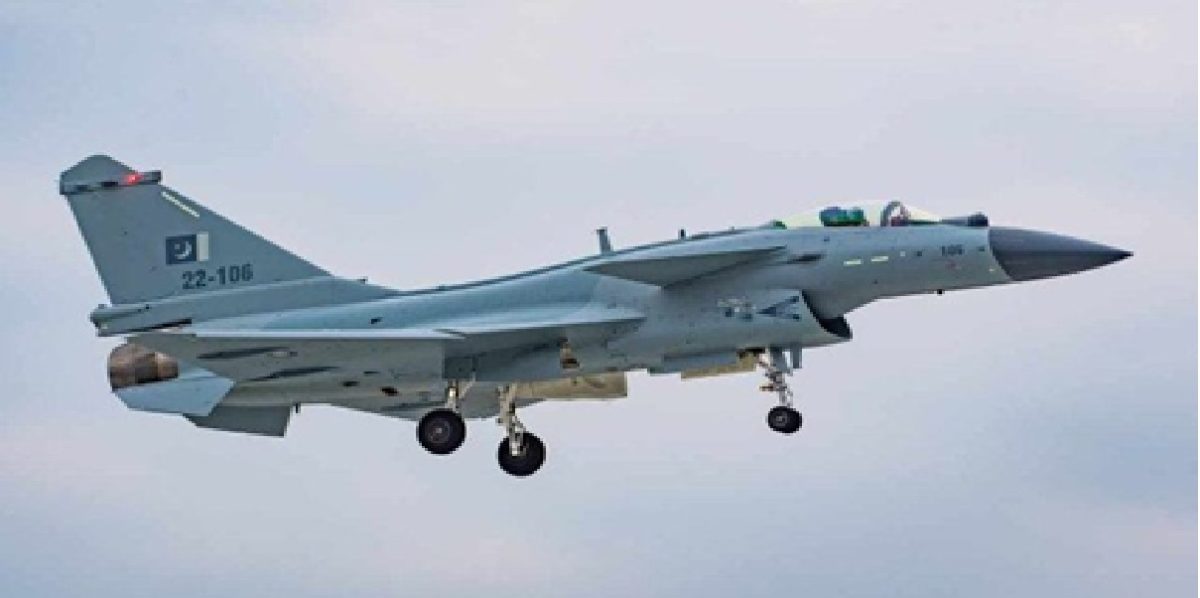
Chinese Celebrate J-10C Triumph Over Rafale in India-Pak Tensions, Applaud PL-15 Missile’s Range and Air Superiority Edge
Recent reports from Chinese state-affiliated media have stirred regional interest by celebrating what they describe as the superior performance of China’s J-10C multirole fighter jets over India’s French-origin Rafale aircraft during heightened India-Pakistan military tensions. The reports especially spotlight the role of the PL-15 long-range air-to-air missile, positioning it as a symbol of China’s growing edge in aerial warfare capabilities.
While the exact details of the India-Pakistan encounter remain ambiguous, Chinese narratives have focused on an alleged standoff in which Pakistan Air Force’s J-10C jets, equipped with Chinese PL-15 missiles, supposedly challenged the Indian Air Force’s Rafale fighters. The J-10C, a key asset in the Pakistan Air Force’s modern fleet, has been promoted in Chinese media as a technological equalizer, especially with its integration of the PL-15 missile system. This missile, with a reported range exceeding 200 kilometers, is believed to outclass the Meteor missile carried by India’s Rafale jets in both range and electronic warfare resistance.
Chinese military analysts have praised the J-10C’s radar and avionics upgrades, particularly its Active Electronically Scanned Array (AESA) radar, which allows it to detect and engage multiple targets at long distances. In contrast, they argue, while the Rafale is a highly capable platform, its performance can be compromised by electronic countermeasures and limitations in missile range.
The PL-15’s perceived advantages stem from its dual-pulse rocket motor and advanced guidance systems, enabling mid-course updates and terminal homing for improved kill probability. Chinese sources claim that in a hypothetical beyond-visual-range (BVR) engagement, the PL-15 gives the J-10C a first-shot advantage, a critical factor in modern air combat.
The celebration in Chinese media goes beyond mere military comparisons. It’s portrayed as a testament to China’s technological self-reliance and its rising influence in shaping regional security dynamics. For Pakistan, the induction of the J-10C represents a significant capability boost, helping to narrow the qualitative gap with India’s air force, which has traditionally held superiority in terms of both numbers and technology.
Indian analysts, however, have largely dismissed the Chinese claims as exaggerated and lacking credible evidence. They argue that the Rafale, with its advanced Spectra electronic warfare suite and Meteor missile, remains one of the most formidable fighter aircraft in South Asia. Nonetheless, the exchange highlights how advanced airpower is increasingly becoming a central theme in strategic narratives across Asia.
This episode underlines the growing use of military achievements as tools for geopolitical messaging. For China, showcasing the J-10C and PL-15 is not just about defense—it’s about prestige, regional influence, and demonstrating the effectiveness of its defense exports, particularly to close allies like Pakistan.
In conclusion, while independent verification of these claims remains elusive, the celebration surrounding the J-10C and PL-15 in Chinese circles reflects broader strategic goals. It signals China’s intent to challenge Western defense superiority and deepen military ties with partners counterbalancing India’s regional clout.