
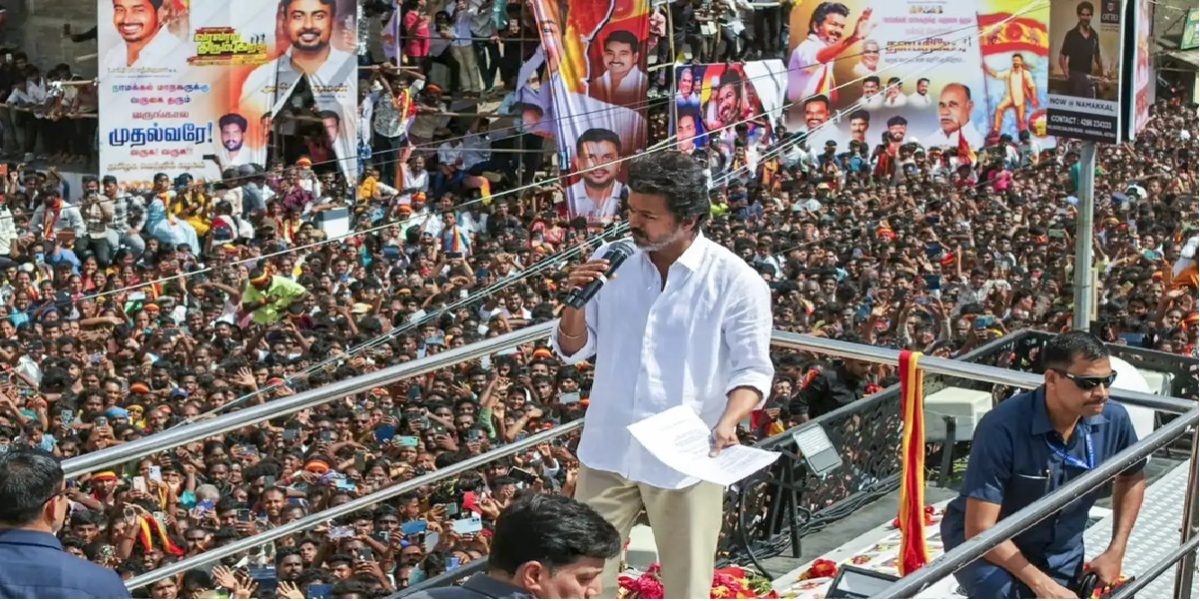
A survivor of the tragic Karur stampede has moved the Madras High Court, seeking a judicial restraint on any further political gatherings by the TVK (Tamilaga Vettri Kazhagam) until safety protocols are assured. The petition contends that granting permission for future rallies would risk repeating the calamity unless stringent measures are first mandated.
The petition arises from the horrifying stampede at a TVK rally, during which exuberant crowds surged uncontrollably, leading to multiple casualties and serious injuries. The petitioner asserts that the disaster was no mere accident but the foreseeable outcome of poor planning, overcrowding, and severe neglect of public safety. He claims that barricades were insufficient, crowd control was inadequate, and the campaign vehicle’s positioning further incited dangerous movement among attendees.
Having personally suffered injuries in the crush, the petitioner implores the Court to withhold approval for more TVK events until independent investigation is completed and clear directives are established to prevent recurrence. The plea stresses that the State’s ex gratia payments and appointment of a one‑man commission, while welcome, do not guarantee that future events will be safeguarded.
An urgent hearing was proposed even on a Sunday, but the Court declined to proceed immediately because the petition had not yet been formally filed or assigned a number. Subsequently, another petition seeking an independent probe into the stampede is slated for hearing before the Madurai bench of the High Court on 29 September 2025.
In its petition, the survivor describes how, as the crowd swelled around the rally site, people were pushed forward relentlessly. The lack of barricading or proper police containment allowed the throng to jostle freely, destabilizing individuals—men, women, children alike—who collapsed under pressure, suffocated, or were trampled.
The petitioner alleges that organizers invited this disaster by permitting unrestricted congregation, deploying the campaign vehicle in a provocative way, and failing to anticipate or manage the crush. He warns that allowing TVK to hold further rallies before accountability is assured would amount to reckless disregard for public life.
Beyond seeking a prohibition on future rallies, the petition presses for court‑ordained safety standards, oversight, and perhaps conditional permission only after independent audits. The underlying demand is that public gatherings with political significance must not proceed on faith alone—they ought to satisfy rigorous scrutiny and preventive safeguards.
As the matter awaits further judicial consideration, it raises critical constitutional, administrative, and public safety questions: To what extent may public authority tacitly permit mass assemblies when risk is evident? Can the Court condition freedoms of assembly and expression on demonstrable protective measures? And is permission for rallies a right or a regulated privilege contingent on safety compliance?
In sum: a Karur stampede survivor has challenged further TVK rallies in the Madras High Court, asking for a moratorium on political gatherings until independent probes conclude and robust safeguards are legally imposed — lest history repeat itself.