
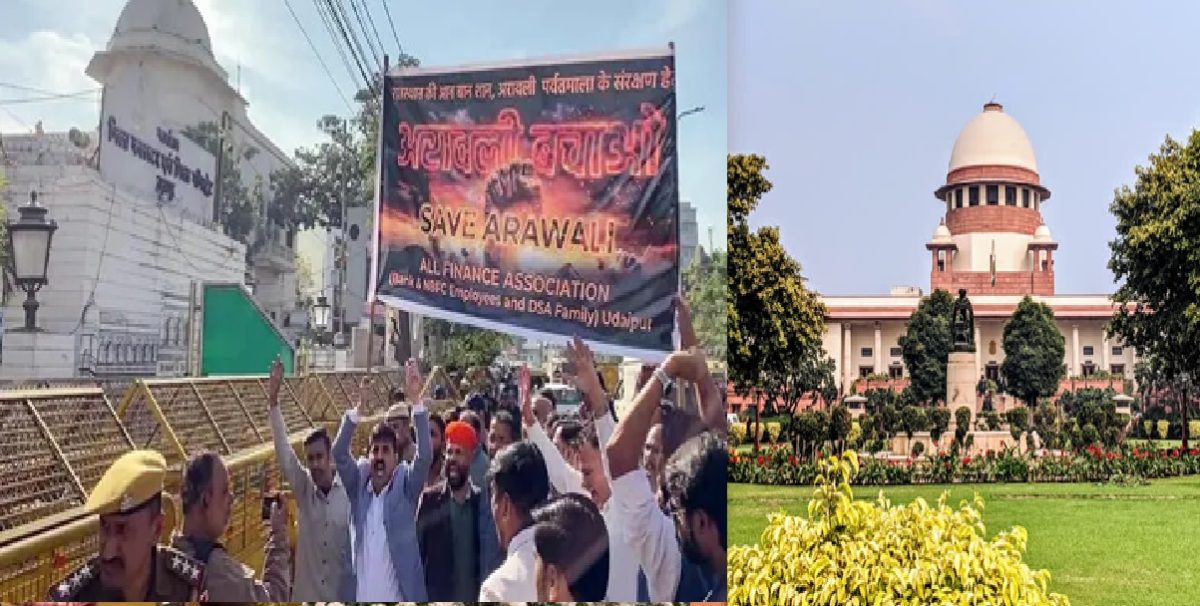
In a significant legal shift, the Supreme Court of India has taken suo motu cognisance of the ongoing row surrounding the legal definition of the Aravalli Hills. A special vacation bench, headed by Chief Justice Surya Kant, is set to hear the matter on Monday, December 29, 2025. This intervention comes as environmentalists warn that a narrow, height-based definition could serve as a “death warrant” for one of the world’s oldest mountain ranges.
The Controversy: What is the “100-Metre Rule”?
In November 2025, a previous bench of the Supreme Court accepted a uniform definition proposed by the Ministry of Environment, Forest and Climate Change (MoEFCC). Under this rule:
-
Aravalli Hills: Defined only as landforms rising 100 metres or more above the local ground level.
-
Aravalli Range: Clusters of two or more such “hills” located within 500 metres of each other.
While the government argues this brings much-needed administrative clarity to 37 districts across Delhi, Haryana, Rajasthan, and Gujarat, critics are sounding the alarm. Internal assessments, reportedly from the Forest Survey of India (FSI), suggest that this threshold could exclude over 90% of the Aravalli landforms in Rajasthan alone, as many ecologically vital ridges and hillocks are lower than 100 metres.
The “Mining Loophole” Fears
The primary concern is that any landform falling below the 100-metre mark would no longer be legally classified as “Aravalli,” potentially exempting it from the strict mining bans currently in place. Environmentalists argue:
-
Ecological Amputation: Protecting only the highest peaks ignores the foothills and low ridges that are critical for groundwater recharge and wildlife corridors.
-
Desertification Shield: The Aravallis act as a “green wall” preventing the eastward spread of the Thar Desert. Fragmenting the range by allowing mining on “lower” hills could accelerate soil erosion and dust storms in the Delhi-NCR region.
The Court’s Current Stance
The Supreme Court’s decision to initiate a suo motu case signals a willingness to re-examine if “administrative convenience” has trumped “ecological integrity.”
Currently, a temporary freeze is in effect:
-
No new mining leases are to be granted until a comprehensive Management Plan for Sustainable Mining (MPSM) is finalized by the Indian Council of Forestry Research and Education (ICFRE).
-
The court has emphasized that the Aravallis are a “national asset” and their destruction poses a “great threat to the ecology of the nation.”
As the hearing approaches, the focus remains on whether the judiciary will revert to a more holistic, slope-based definition (protecting land with a 3-degree incline or more) as previously suggested by experts, rather than a simple height metric.