
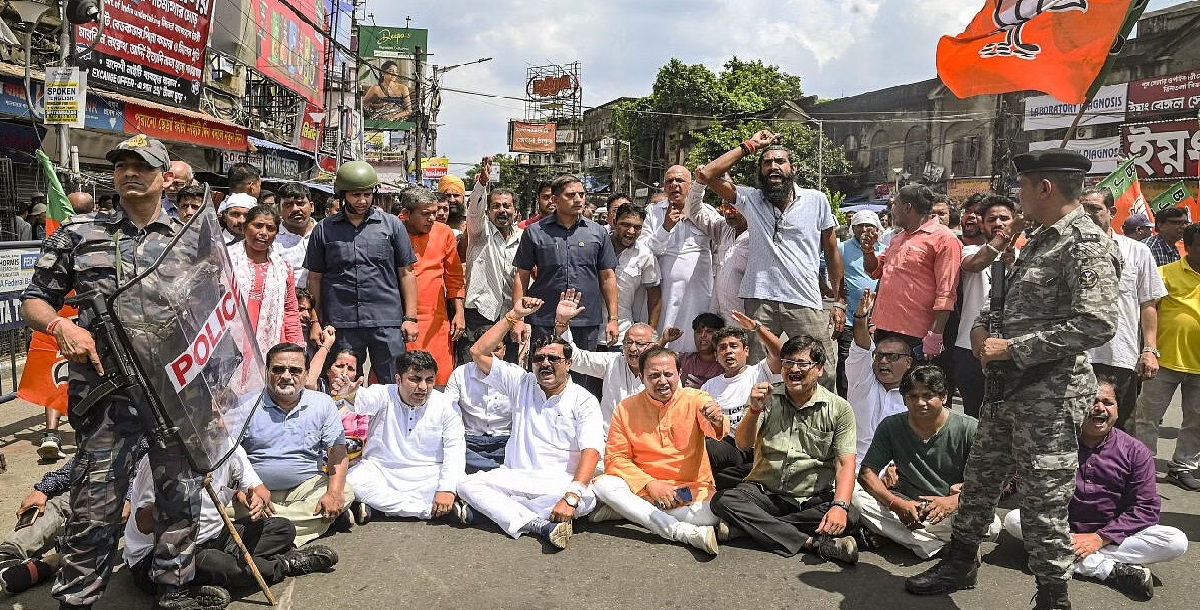
In the wake of a tumultuous day in Nandigram, West Bengal, the political landscape has been sharply divided as the Bharatiya Janata Party (BJP) has announced a 12-hour ‘Bengal Bandh’ in protest against the state government’s handling of recent demonstrations. The call for the bandh comes after a violent confrontation between protestors and police forces during the Nabanna Abhiyan—a movement aimed at highlighting various grievances against the state administration.
The confrontation on the previous day saw police employing lathi charges and tear gas against demonstrators, who had gathered in large numbers to voice their dissatisfaction with the state government’s policies and actions. The use of force has drawn widespread condemnation and has intensified political tensions in the region. The BJP, with its influential leader Suvendu Adhikari at the forefront, has mobilized its supporters to join the protest and demand accountability from the state government.
Suvendu Adhikari, the Leader of the Opposition in West Bengal, has been vocal about the perceived injustices and inefficiencies within the state administration. His participation in the BJP-led protest underscores the party’s strategy to leverage the incident to galvanize public sentiment against the ruling government. The BJP’s decision to call for a ‘Bengal Bandh’ reflects their attempt to capitalize on the unrest and demonstrate their opposition to the state’s governance.
The 12-hour bandh, scheduled to disrupt normal activities across West Bengal, aims to draw attention to the alleged police brutality and to press for a review of the state government’s response to peaceful protests. The BJP asserts that the heavy-handed tactics used by the police are indicative of a broader pattern of repression and authoritarianism. By calling for a bandh, the party hopes to amplify its message and apply political pressure on the state administration.
The Nabanna Abhiyan, which translates to ‘March to Nabanna’ (the state secretariat), was organized to protest various issues including governance failures, alleged corruption, and economic mismanagement. The crackdown by police has been widely criticized by opposition parties and civil rights groups, who argue that the use of force against peaceful protestors is an infringement on democratic rights and freedoms.
In response to the BJP’s bandh call, the state government has defended its actions as necessary to maintain order and ensure public safety. Officials claim that the police response was proportional to the threat posed by the protesters, who were reportedly engaging in violent and disruptive behavior. The government maintains that it is committed to upholding the law while addressing the concerns of its citizens through appropriate channels.
The situation has stirred significant debate across the political spectrum. Supporters of the BJP view the bandh as a legitimate form of protest against an oppressive regime, while critics argue that it disrupts daily life and can lead to further polarization. The broader implications of the bandh and the violence during the Nabanna Abhiyan could influence upcoming elections and shape public perception of both the BJP and the ruling party in West Bengal.
पीएम मोदी 2 सितंबर को बीजेपी के सदस्यता अभियान की औपचारिक शुरुआत करेंगे
As the bandh unfolds, it will likely test the resilience of West Bengal’s political climate and the public’s tolerance for disruption. The state government’s handling of the situation and the BJP’s ability to mobilize support will be closely watched, with potential ramifications for both local and national politics. The coming days may reveal how effectively both sides can navigate this volatile environment and whether a path toward resolution and dialogue can be found amidst the unrest.