
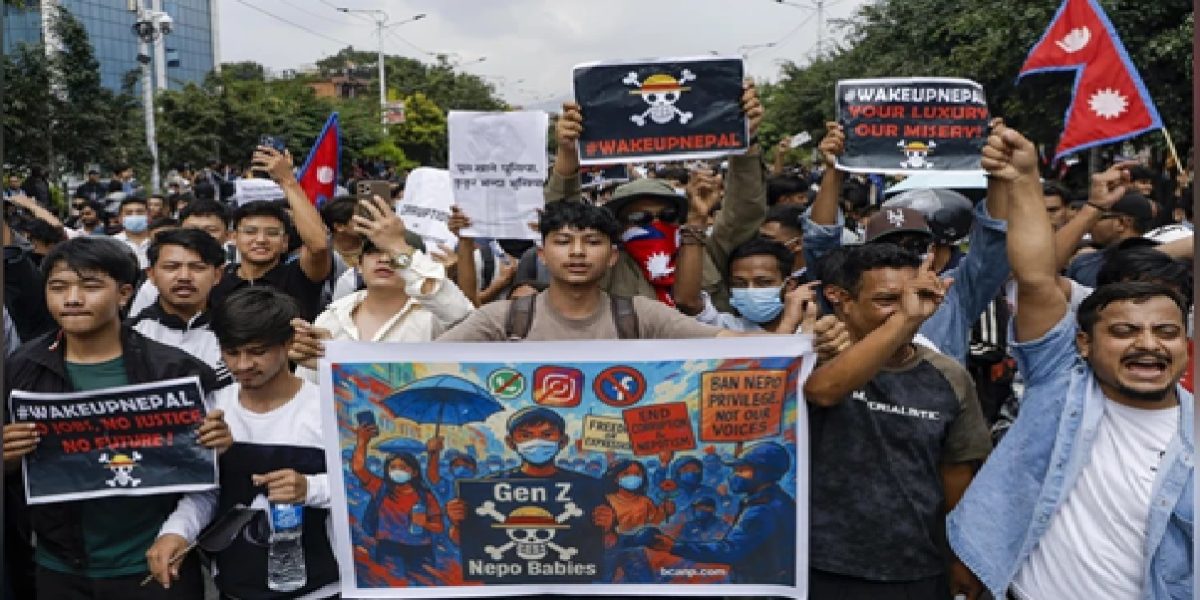
Nepal Erupts on Day 2 of Gen Z Protests as Oli Government Falls Amid Widespread Unrest and Political Turmoil
Nepal is witnessing one of the most volatile political upheavals in recent memory, with Generation Z taking center stage in a powerful and unprecedented protest movement. On the second consecutive day of mass demonstrations, the long-controversial Oli government collapsed under immense public pressure. What began as a student-led outcry against authoritarian policies has now turned into a nationwide rebellion demanding deep systemic change.
The protests, largely organized through social media platforms like TikTok, Instagram, and X (formerly Twitter), have rapidly evolved from peaceful sit-ins to mass mobilizations that have paralyzed major cities. Kathmandu, in particular, has become the epicenter of dissent. Tens of thousands of youth have taken to the streets, waving Nepali flags, chanting slogans for democracy, and demanding accountability from political elites who they believe have failed the country.
Former Prime Minister K.P. Sharma Oli resigned earlier today after protestors stormed Singh Durbar—the administrative heart of Nepal—and briefly took control of sections of the parliament complex. Videos of youth occupying government buildings went viral within hours, sending shockwaves across South Asia and drawing international attention to the crisis unfolding in the Himalayan nation.
The anger of Gen Z protestors is rooted in years of disillusionment with governance, unemployment, corruption, and suppression of free speech. Many young Nepalis accuse Oli’s administration of silencing critics, undermining the constitution, and prioritizing power over public welfare. While the spark may have been lit by a controversial law aimed at regulating online speech, the fire has engulfed broader issues—inequality, education reform, lack of job opportunities, and political accountability.
Unlike past movements, this uprising is leaderless but highly coordinated, with digital activism playing a key role. Protestors have also received support from artists, journalists, and civil society members, turning it into a cross-generational call for reform. Protestors have made it clear that they are not aligned with any political party but are instead demanding a complete overhaul of the system.
In the wake of Oli’s resignation, Nepal finds itself at a political crossroads. The president has called for an emergency meeting with major parties to chart out the next steps. However, the protestors remain firm: they want more than a change in leadership—they want structural transformation.
Security forces have so far exercised restraint, though some clashes were reported near government buildings. The international community, including the United Nations and neighboring India and China, have issued statements urging calm and advocating for democratic dialogue.
As Nepal stands on the edge of a political reset, one thing is clear: Generation Z has arrived as a powerful political force. Their message is loud and unmistakable—Nepal needs change, not just new faces in old positions, but a rethinking of what leadership, justice, and governance mean in the 21st century.